
A front splitter changes how a car looks from the front and protects the bumper edge from curbs and speed bumps. Whether you want a subtle lip, a custom chin splitter, or a carbon fiber design, the difference between one that looks bolted on and one that looks like it belongs to your vehicle comes down to the right fit, material choice, and understanding your specific car’s front end.
At Jawharat Al Sahil, we make and fit car front splitters and lips in Sharjah at our Industrial Area 12 workshop, handling custom fabrication, carbon fiber options, and fitting work across BMW M models, Dodge performance cars, and SUVs. We’ve worked on front splitter installations across a range of makes and models, and that experience goes into how we approach each project.
If you’re considering a front splitter or lip for your car, send us photos on WhatsApp and we’ll talk through what’s realistic for your vehicle.
Car Front Splitter Services at Our Sharjah Workshop
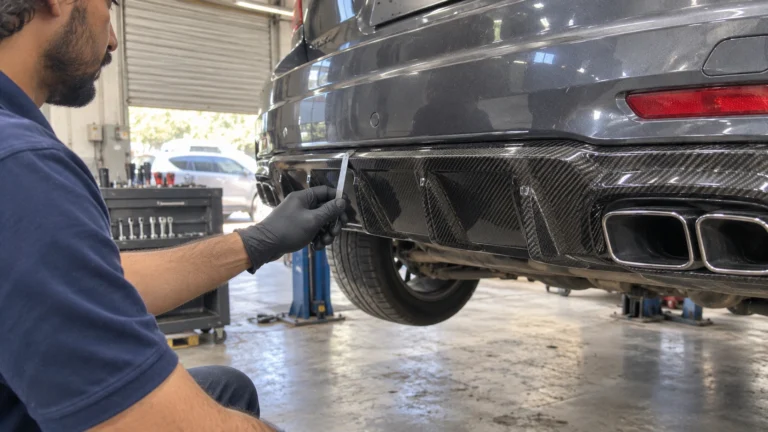
A front splitter installation involves more than just bolting a new part onto the bumper. Getting the alignment right, managing the gap between the splitter and the body, and ensuring ground clearance won’t cause scraping all matter to the final result. The splitter needs to sit flush against the bumper or the underside of the front end, with even spacing on both sides, so any misalignment becomes visible once the car is parked next to another vehicle.
Front splitters also need to account for the bumper’s existing contours, any integrated fog lights or air intakes, and the car’s overall ride height. A splitter that looks aggressive on a different vehicle might not work on yours if the proportions aren’t right. This is where workshop experience matters—we know how to keep a splitter looking intentional rather than just bolted on.
Custom Car Front Splitter Fabrication
We shape custom front splitters by hand around your specific vehicle, rather than pulling a generic one off a shelf. This approach means the splitter sits correctly on your car’s unique front end lines, not just fitting “close enough.” When a splitter is shaped for your car specifically, the gap sits evenly, the part feels integrated rather than added on, and the overall appearance is much cleaner.
Handmade splitters take longer to produce than off-the-shelf options, but the fitting work at the end is usually simpler since the part was already shaped to your vehicle. We take reference measurements from your car during the design phase and use those to guide the shaping process. The result is a splitter that looks intentional on your specific car, not generic.
Custom splitters can be simple chin extensions under the bumper or more dramatic designs that reshape the entire lower front end. We discuss what you’re after and what’s realistic for your car’s design before we start shaping.
Carbon Fiber Front Splitters
Carbon fiber front splitters are used when weight reduction and a visible weave finish are priorities. Carbon fiber is lightweight and has a distinctive appearance, but it’s typically more expensive and more brittle than fiberglass or ABS. We use genuine carbon fiber for customers who specifically want the performance and aesthetic benefits and understand the trade-offs.
Carbon fiber also requires careful handling during fitting and transport, since impact can cause cracking or delamination. We take extra care during installation to ensure the part is mounted securely and protected from damage. The distinctive black weave finish of carbon fiber is part of the appeal—it looks like a performance upgrade, and it is one.
For BMW M models and other performance cars, genuine carbon fiber front splitters are a popular choice because they add visual aggression while reducing unsprung weight. We source and fit genuine carbon fiber parts for customers who want authenticity.
Car Front Bumper Lips and Chin Splitters
A front bumper lip is a smaller, subtler addition to the bottom of the bumper that adds a minimal aerodynamic line. A chin splitter is a more pronounced extension that sticks out further and creates a more aggressive look. Both serve similar purposes—protecting the bumper edge and adding visual interest—but they’re different parts.
Lips are usually made from flexible materials like ABS or polyurethane and can be adhesive-mounted to a clean bumper. Chin splitters are typically bolt-on and may require more substantial support. We fit both styles depending on what you’re after and what your car’s bumper can support.
Some cars come factory with a lip already, and customers want to upgrade it to a larger splitter. Others want to add a lip where there wasn’t one before. We discuss your starting point and your goal during the quote phase.
Front Splitter Fitting for Your Bumper
Different bumpers have different structures, so the fitting approach varies. A BMW M bumper has different mounting points than a Charger bumper, and those differences matter to how secure and aligned the splitter will be. We’ve fitted splitters on factory bumpers, aftermarket sport bumpers, and custom bumpers, and adjust our process based on what you have.
Fitting also depends on whether your bumper is in good condition or has damage. A warped, dented, or cracked bumper will affect how the splitter sits. We inspect the bumper as part of the quote process and let you know if repair or replacement is needed before we fit the splitter. If you’re planning a bigger front-end change, our bumper modification work covers sport and custom bumpers that can be paired with a splitter.
Ready to Transform Your Car?
From handmade body kits to real carbon fiber upgrades, tell us what you have in mind. Send your car photos and get a quote before any work begins.
Front Splitter vs Front Lip
People use the terms “front splitter,” “front lip,” “front bumper lip,” “front bumper spoiler,” and “chin splitter” to describe different parts, and sometimes they overlap. Understanding the difference helps you decide what you want.
| Aspect | Front Lip | Front Splitter | Chin Splitter | Front Bumper Spoiler |
|---|---|---|---|---|
| Shape | Subtle undersection on bumper edge | More pronounced horizontal section below bumper | Aggressive chin extension under bumper | Lip-like or splitter-like depending on design |
| Purpose | Adds minimal aerodynamic line, protects bumper edge | Protects bumper edge, reduces air flow under car, adds aggression | Maximum ground effect and visual impact, shields undercarriage | Similar to lip or splitter depending on style |
| Mounting | Usually adhesive or small bolts to bumper edge | Bolt-on with backing plates or support brackets | Bolt-on to frame or structural points | Varies: adhesive or bolt-on |
| Best For | Factory-looking upgrades, minimal visual change | Balanced aggression and function, everyday cars | Track cars, show cars, extreme styling | Cars where you want a lip-like or splitter-like appearance |
| Complexity | Simple, fast to install | Moderate, requires alignment and mounting work | Complex, may need frame support or bumper modification | Varies depending on design |
| Ground Clearance Impact | Minimal | Moderate, may affect speed bumps | High, serious scraping risk on normal roads | Varies depending on design |
A front lip is the subtle choice for someone who wants a small upgrade. A front splitter is the balanced choice for aggression plus function. A chin splitter is for someone who wants drama and doesn’t care about scraping. The terms overlap because manufacturers use them differently, so describe what you want visually during the quote and we’ll clarify which part suits your car.
Front Splitter Materials for Sharjah’s Heat
The material you choose affects both how the splitter looks and how long it holds up in Sharjah’s climate. Choosing the right material for local conditions is part of what makes a modification successful long-term.
Carbon Fiber, Fiberglass, ABS and Polyurethane
Carbon fiber is lightweight and has a distinctive woven appearance. It’s the strongest material per unit of weight, making it popular for performance cars. Carbon fiber is expensive and brittle, so it’s reserved for customers who want the performance benefit and aesthetic and understand the trade-offs. Genuine carbon fiber is heavier to source but looks authentic. Fake carbon (printed plastic) is cheaper but looks less convincing.
Fiberglass is a common choice for custom and aftermarket splitters because it holds shape well and can be hand-shaped to match your car. It’s straightforward to work with for shaping and repairs if minor damage occurs. Fiberglass does require a protective coat or paint to hold up to UV exposure, which is why finishing work is important.
ABS is a rigid plastic that’s commonly used for aftermarket splitters because it offers a good balance of strength and flexibility. ABS is durable and can tolerate minor impacts better than carbon fiber. It’s often used for lips and smaller splitter designs because it’s lighter and easier to mount than heavier materials.
Polyurethane is flexible and durable, making it practical for splitters that might face minor impacts from curbs or speed bumps. It’s also easier to repair than carbon fiber or fiberglass if damage occurs. Polyurethane can be adhesive-mounted or bolt-on depending on the design.
Curbs, Speed Bumps and Scrape Protection
A front splitter’s main practical purpose is to protect your bumper and undercarriage from curbs and speed bumps. Because the splitter sits lower than the bumper, it takes the first hit instead. This is why splitter material matters—a brittle material might crack, while a flexible one might bend and bounce back.
In Sharjah, curbs are common and speed bumps are aggressive. A splitter gives you a sacrificial shield that you can replace if it gets damaged, rather than replacing the entire bumper or fixing undercarriage damage. This is why many customers choose splitters—they’re cheaper to repair than what they protect.
Curb scraping is the most common damage. If you’re parking in tight spaces or driving in areas with aggressive curbs, a flexible material like ABS or polyurethane might be wiser than brittle carbon fiber. A carbon fiber splitter is beautiful but unforgiving.
Speed bump damage is different—the car’s weight comes down on the splitter as you cross a bump, so a rigid material handles this better than a flexible one. The trade-off is that a rigid splitter might crack instead of bending.
We discuss your driving environment during the quote phase and recommend a material that suits how you actually drive, not just how you want the car to look.
| Material | Strength vs Impact | Curb Damage Tolerance | Speed Bump Tolerance | UV Resistance | Heat Tolerance | Cost | Repairability |
|---|---|---|---|---|---|---|---|
| Carbon Fiber | Very High | Low (cracks) | High | Good with seal | Moderate | High | Low (requires specialist) |
| Fiberglass | High | Moderate | High | Fair without seal | Good | Moderate | Moderate (can patch) |
| ABS | Moderate | Moderate (dents/bends) | Moderate | Good | Moderate | Moderate | High (can heat-form) |
| Polyurethane | Moderate | High (flexible) | Moderate | Good | Good | Moderate | High (can patch/replace) |
Front Splitter and Lip Fitting for Popular Cars
Different vehicles have different front end structures, so the splitter work varies from one make to another. The bumper design, grille position, and overall proportions change the approach.
BMW M Models
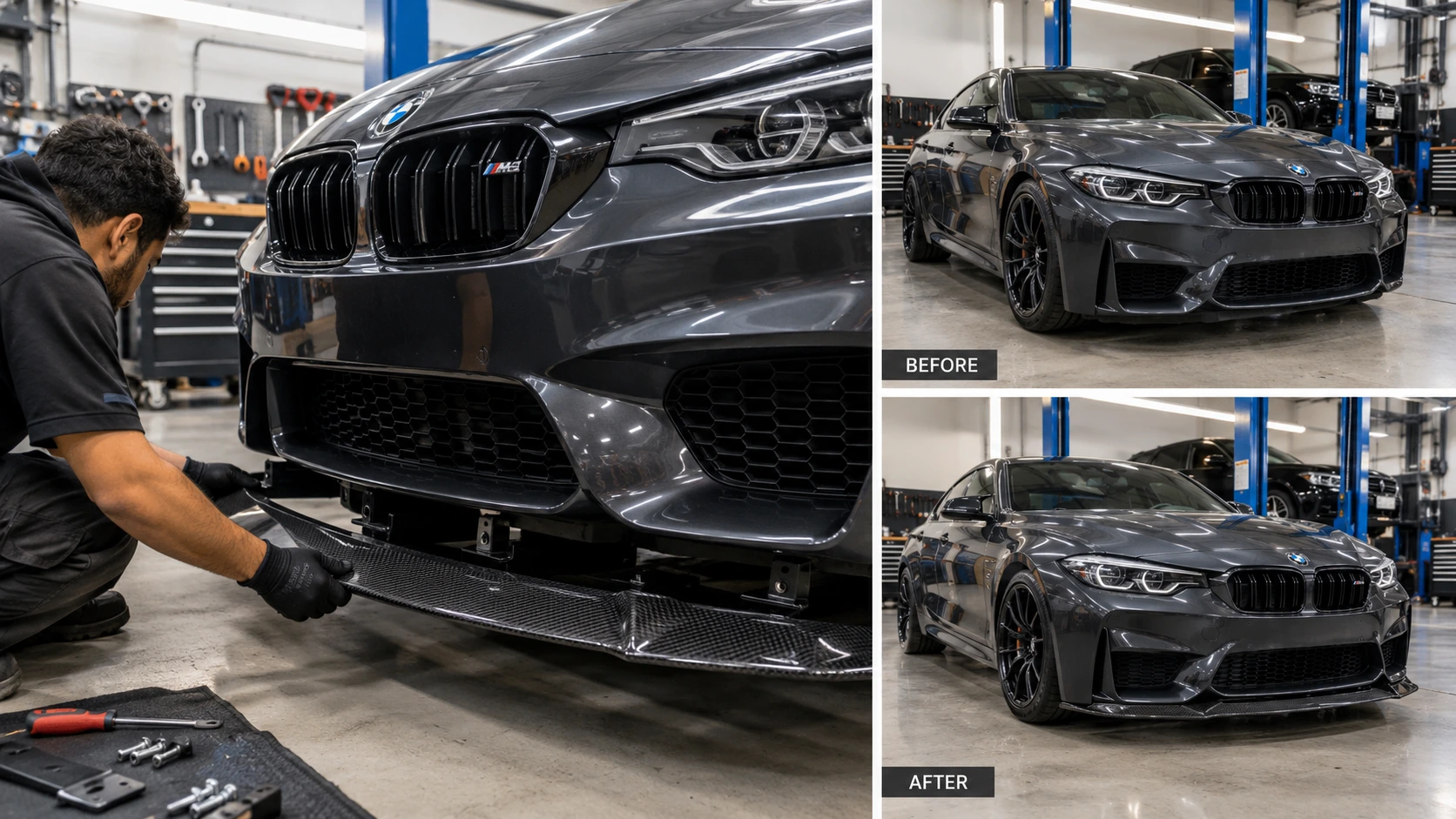
Performance BMWs are popular for front splitter upgrades, particularly M3, M4, and M440i models. BMW bumpers have distinctive shapes and integrated air intakes, so a splitter needs to respect those lines while adding aggression. We source genuine carbon fiber front splitters for BMW M models, or we can fabricate custom designs that extend the factory aggression.
BMW M bumpers are precision-engineered, so fitting a splitter requires careful alignment to maintain the factory look while adding impact. We’ve worked on enough BMWs to know how to keep a splitter looking like it came from the factory rather than bolted on afterward.
Carbon fiber front splitters on BMW M cars are particularly effective because they match the factory M aesthetic and reduce unsprung weight, which handles use enthusiasts appreciate.
Dodge Charger and Challenger
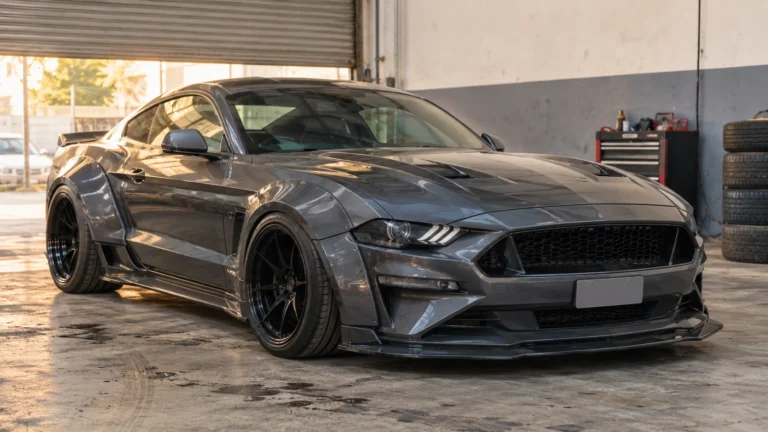
American muscle cars like the Charger and Challenger benefit dramatically from front splitter upgrades. These cars have broad, aggressive front ends that can carry substantial chin splitters without looking out of proportion. A Dodge splitter often extends across the full width of the bumper and sticks out noticeably, creating a street-fighter look.
Charger and Challenger splitters are usually bolt-on because of the weight and the leverage they create. We secure them to frame points rather than just the bumper to ensure they don’t shift or rattle at highway speed. Some customers pair their splitter with a front bumper upgrade for a complete front-end transformation.
The bold lines of a Dodge benefit from a splitter that matches that aggression. Understated doesn’t work on a muscle car—go bold or don’t bother.
Toyota Land Cruiser and Lexus LX
Large SUVs like the Land Cruiser and LX have substantial front bumpers that can handle splitter work, but the proportions are different from sedans. A splitter on an LX needs to sit correctly relative to the bumper’s curves and the vehicle’s overall mass. Too small and it looks lost, too large and it looks out of place.
We typically fit smaller, more integrated splitters on these vehicles rather than dramatic chin extensions. The goal is to sharpen the front end rather than make it look like a race car. Some customers want a subtle lip upgrade, others want a more pronounced chin splitter. We discuss proportions during the quote phase.
Land Cruiser and LX splitter work often pairs with other front-end modifications like grille upgrades or bumper restyling. A complete front-end refresh makes more visual sense than a splitter alone on these large vehicles.
Front Splitter Mounting and Fit Checks
Getting a front splitter right depends on more than just the part itself. Alignment needs to be perfect, mounting needs to be secure, ground clearance needs to be realistic, and any integrated parts need to function correctly. We check all of this before handing the car back to you.
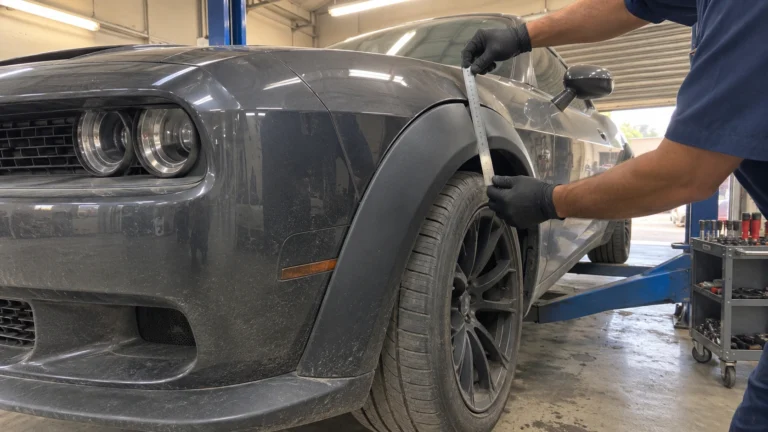
Alignment means the splitter sits flush against the bumper or the underside of the front end on both sides, with even spacing top and bottom. A splitter that’s off by a few millimeters on one side becomes immediately visible. We use spacers and adjust mounting points to get the alignment uniform.
Mounting security matters for both safety and appearance. A splitter that’s properly mounted won’t rattle or shift, and it won’t look like it’s about to come loose. We use structural mounting with proper backing plates and hardware rather than relying on adhesive alone in high-stress areas. For heavier designs like chin splitters, we anchor to frame points to ensure they can handle highway speeds and curb impacts.
Ground clearance is tested during the handover check. We drive the car slowly over a curb or speed bump to confirm the splitter clears without damage. If ground clearance is tight, we discuss this with you and may recommend modifications or advice on how to drive the car to avoid damage.
Bumper integration means the splitter looks like it belongs to the bumper, not just stuck on top. We use color matching, gap management, and mounting visibility to create a cohesive look. If your splitter is being painted, we confirm the finish matches the bumper before handing the car back.
Front Splitter Finish and Paint
We fit splitters and ensure proper alignment and mounting. If your new splitter requires painting or color matching, we can discuss your options during the quote stage. Some customers arrange painting separately through a paint shop and bring the splitter to us already finished. Others prefer pre-painted parts that we fit directly. Some customers accept that the splitter will be primed or raw and arrange painting later.
We don’t offer painting as part of our service, so this is a conversation to have during the initial quote. The splitter we fit will be properly mounted and aligned, but the final paint finish is something we discuss as a separate step depending on what you need and prefer.
Carbon fiber splitters typically don’t need painting—the weave is the finish. If you want a gloss clear coat over the carbon, that’s a separate step you can arrange.
Car Front Splitter Cost in Sharjah
Cost depends on several factors rather than a fixed rate across all splitter work. Understanding what affects the price helps you make informed decisions about what level of modification makes sense for your vehicle and budget.
What Changes the Price: Car, Material and Fitting
Your vehicle’s make and model affects the cost because different vehicles have different bumper structures and complexity. A BMW requires different work than a Dodge, and an SUV requires different work than a sedan.
The splitter type and material you’re after plays a big role. A simple adhesive lip costs less than a full bolt-on carbon fiber chin splitter. Handmade custom splitters cost more than off-the-shelf options because of the time investment in shaping and fitting. Carbon fiber costs significantly more than ABS or fiberglass.
The mounting method changes the price. Adhesive mounting is faster and costs less than bolt-on work, which requires drilling, backing plates, and frame securing. However, bolt-on is more secure and necessary for heavier designs.
The amount of fitting work required depends on whether the bumper needs prep, whether the splitter needs painting, whether ground clearance needs adjustment, and whether integrated parts are involved. A straightforward fit-and-go splitter costs less than one that requires bumper work, painting coordination, or electrical routing.
Customer-Supplied Splitter vs a Splitter We Make
Some customers bring their own splitter and just need fitting work. Others want us to supply the part. If you have a splitter already, we can fit it and handle any mounting or integration work needed. If you want us to supply the splitter, we discuss material, type, and design during the quote phase and provide a price for the complete package.
The cost difference depends on what you’re starting with and whether custom fabrication is involved. A ready-made splitter that you supply costs less in labor than a handmade custom splitter we fabricate. Genuine carbon fiber splitters (sourced from performance parts suppliers) cost more than generic aftermarket splitters.
Written Quote After Photos
We provide a quote after reviewing photos of your car, the splitter you want (or if you have one to supply), and your goals. The quote includes the splitter itself (if we’re supplying it), the mounting method, any bumper prep, painting coordination, and a final fit check. This happens before any work begins, so there are no surprises partway through.
Time Needed for a Front Splitter Job
How long a front splitter installation takes depends on whether the work is straightforward fitting or includes custom shaping, painting, or bumper prep.
A simple adhesive lip installation might take a few hours to a day. A bolt-on splitter might take a day or two depending on bumper condition and any integration work. A handmade custom splitter could take 1-2 weeks depending on the design complexity and material. We give a time estimate with each quote so you know what to expect.
If your bumper needs prep—cleaning, repair, or repainting—that adds time. If the splitter needs to be painted to match your car, that’s additional time depending on whether we’re painting it or coordinating with a paint shop.
Custom fabrication always takes longer, but the result is a splitter that’s been shaped specifically for your vehicle.
Front Splitter Damage and Function
A front splitter’s primary function on a street car is protective and visual. It shields your bumper and undercarriage from curbs and speed bumps, and it changes how the front of your car looks. On a track car, a splitter creates downforce by managing air flow under the vehicle. On a street car, that aerodynamic function is secondary to the protective and visual benefits.
Damage to a front splitter usually comes from curbs, speed bumps, or low parking lot approaches. Because the splitter sits lower than the bumper, it takes impacts that would otherwise hit the bumper directly. This is intentional—a damaged splitter is cheaper to replace than a damaged bumper or undercarriage.
Different materials handle damage differently. Carbon fiber can crack or delaminate if hit hard. Fiberglass can crack or chip. ABS and polyurethane can dent or bend. We discuss damage risk and material durability during the quote phase based on your driving environment.
Function depends on the design. A lip adds minimal aerodynamic function but significant visual impact. A full-width chin splitter manages more air flow and provides more protection. A carbon fiber performance splitter is designed for both looks and aerodynamics.
Don’t expect a street splitter to make your car handle dramatically better or go faster—most of that benefit is visual. If you want aerodynamic function, a track-focused splitter with proper angle and support is necessary, and we can discuss that during the quote phase.
Front Splitter Design and Angle
The design and angle of your splitter affect both how it looks and how it performs. A shallow angle (close to horizontal) is more subtle and less likely to scrape. A steep angle (more vertical) is more aggressive and more likely to create curb and bump damage.
Design refers to the overall shape—whether it’s a simple lip, a splitter with fins, a chin extension, or a full-width bar. Simple designs are cleaner and easier to fit. Complex designs with multiple sections or fins are more dramatic but more complex to align and mount.
Angle refers to how much the splitter extends forward and down. A small angle sits closer to the bumper and looks integrated. A large angle sticks out further and looks more aggressive. The trade-off is that a large angle increases the risk of curb and bump damage.
We discuss design and angle during the quote phase based on your car’s proportions, your driving environment, and your risk tolerance for damage.
Rules for Front Splitter Changes in Sharjah
Modification rules can vary depending on how extensive the changes are. A simple lip that doesn’t block lights or obstruct vision is generally straightforward. An aggressive chin splitter that sticks out far or extends beyond the factory bumper width might require approval depending on current regulations.
We’d recommend confirming current approval requirements with the Sharjah Police before proceeding with a splitter installation, particularly for more extensive designs. Rules can change over time, and what’s approved one year might face questions the next, so checking directly with authorities gives you clarity for your specific project.
Our Front Splitter Process
Our process follows four clear steps.
First, you send us photos of your vehicle along with details of what you want, including the car model, year, and current bumper condition. If you have a splitter already, include photos of that too. Describe the look you’re going for—subtle, aggressive, or somewhere in between.
Second, we confirm which splitter suits your car, discuss material and design options, and provide a written quote that outlines the cost, timeline, and what’s included. We’ll recommend a mounting method based on your bumper condition and the splitter’s weight.
Third, once you approve the quote, we carry out the fitting work at our workshop, keeping you updated on progress if the work extends over multiple days. If custom fabrication is involved, we’ll show you progress photos and get your approval before final fitting.
Fourth, we check the fit, alignment, ground clearance, and bumper integration before handing the car back, ensuring the splitter is secure, properly aligned, and looks intentional on your vehicle.
This process keeps surprises out of the project and makes sure you know what to expect before any work begins.
Before and After Front Splitter Work
This section features real photos from completed front splitter and lip installations at our Industrial Area 12 workshop, with the vehicle model, year, splitter type, and material noted for each one. Seeing the before and after gives a clearer sense of what’s achievable than a description alone. Photos show both the overall car and close-up details of splitter fit, alignment, and integration with the bumper.
Legal Approval for Front Splitter Modifications
Before proceeding with any front splitter installation — whether a subtle lip, a standard splitter, or an aggressive chin extension — it’s important to understand Sharjah’s current rules on vehicle modifications. Changes that significantly alter your car’s front profile, extend beyond standard bumper dimensions, or create ground clearance issues may require approval from local authorities.
We recommend reviewing the Sharjah Police vehicle modification guidelines to confirm your specific project is compliant before work begins. This ensures your modified vehicle passes inspection and avoids any issues down the line. If you’re unsure whether your splitter plan needs approval, we can discuss it during your quote stage and point you toward the right authority if needed.
Many customers pair their splitter project with other front-end work. Some add carbon fiber upgrades for a complete performance look, while others combine their splitter with a front bumper upgrade for a full visual transformation. Each project is customized to match the customer’s vision and vehicle specifications.
Front Splitter Workshop Near Sharjah, Ajman and Dubai
Our workshop in Industrial Area 12 is accessible from across Sharjah, including Al Majaz, Al Nahda, Muwaileh, and Al Khan. Customers from Ajman and Dubai also reach us via the E311 and E611 highways. Our exact location and opening hours are available on our website for anyone planning to visit in person.
Customer Reviews
Feedback from past customers is shared in this section, based on genuine reviews from people who’ve had front splitter work done at our workshop. Real customer experiences give the clearest picture of what working with us is actually like.
Ready to Transform Your Car?
From handmade body kits to real carbon fiber upgrades, tell us what you have in mind. Send your car photos and get a quote before any work begins.
Car Front Splitter FAQs
How much does a car front splitter cost in Sharjah?
The price depends on your car’s make, model and year, the splitter type and material, the mounting method, and how much fitting or bumper prep is needed. A simple adhesive lip costs less than a bolt-on carbon fiber chin splitter. We give a written quote after seeing photos of your car, before any work starts.
What’s the difference between a front splitter and a front lip?
A front lip is a subtle undersection on the bumper edge, usually adhesive-mounted, that adds minimal aerodynamic line and visual impact.
A front splitter is a more pronounced horizontal section below the bumper, usually bolt-on, that adds aggression and protects the bumper edge.
A chin splitter is an aggressive extension under the bumper that sticks out further and creates maximum visual impact. The terms overlap—describe what you want visually and we’ll clarify which part suits your car.
Can I get a custom front splitter fabricated in Sharjah?
Yes. We shape custom front splitters by hand around your specific vehicle. This takes longer than fitting a pre-made splitter, but the result is a part that looks intentional on your car. We take measurements during the quote phase and discuss design options before we start shaping.
What materials are front splitters made from?
Front splitters are made from carbon fiber (lightweight, expensive, brittle), fiberglass (shapeable, requires paint or seal), ABS (rigid, durable, forgiving of impacts), and polyurethane (flexible, durable, easy to repair).
We recommend materials based on your car’s design, your driving environment, and your budget. Carbon fiber looks most aggressive but is least forgiving of curb and bump damage.
Are front splitter modifications legal in Sharjah?
Cosmetic splitter changes are generally allowed, but rules can change and larger designs may need approval. Check your plan with the Sharjah Police before work starts. We’ll tell you which parts of your project may need approval.
Do you offer splitter painting?
Our work focuses on splitter fabrication, supply, and fitting: custom and off-the-shelf splitters fitted and checked before handover. Splitter painting is not part of our main services. Tell us what you need and we’ll say whether we can help or point you elsewhere.
Get a Front Splitter Quote on WhatsApp
If you’re considering a front splitter or lip for your car, send us photos of your vehicle through WhatsApp, or get in touch through our website to discuss what’s realistic for your make, model, and the look you’re after.
2 thoughts on “Car Front Splitter in Sharjah: Custom, Carbon and Lip Fitting”